
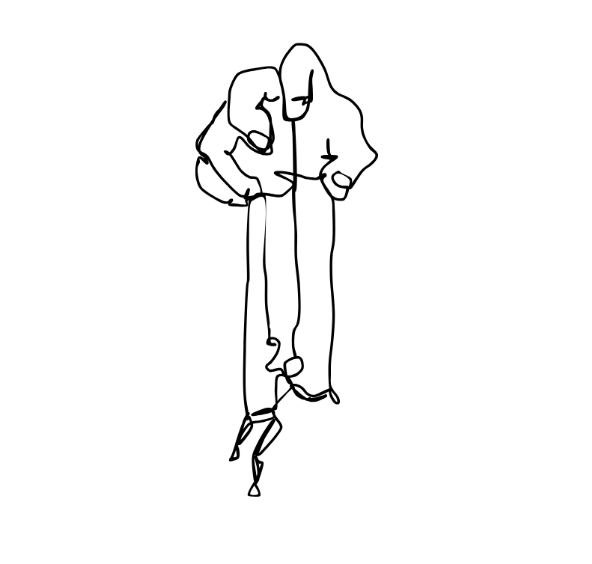
I’ve long considered writing a blog entry about the difficulties of having a relationship with a parent who can be emotionally volatile, or struggles with emotional dysregulation. Many times, I’ve been persuaded against it- usually in my deepest moments of compassion for said parent (also as a result of an enmeshed dynamic). I’ve feared making them feel bad for something that just seems impossible for them not to do. Yet, I am also confronted with a stronger, protective voice- one that’s grown louder and louder the more inner work I have done. This voice reminds me that I am not responsible for my parent’s feelings, that I am my own person, and that it’s okay to hold both compassion and anger toward the behaviours of my parent.
So, here I find myself, wishing to share what I’ve learnt on this journey and how I continue to try and navigate the most difficult relationship in my life.
I’ve decided to split this entry into two parts. Part One, which you’re reading now, focuses on the context of the dynamic: Enmeshment, Cutting the cord, and The Cycle.
Whilst I will be making occasional references to psychoanalytic work, much of what I’m writing is deeply personal and comes from lived experience. I hope that my insights may be helpful. So, take what resonates with you, and leave the rest.
Now that we’ve laid the groundwork, let’s dive in.
PART I
Enmeshment: Understanding the Invisible String

The term enmeshment, for me, encapsulates why it is so excruciatingly difficult to survive an emotionally volatile parent. To be ‘enmeshed’ with a parent is very common in a single parent, only child dynamic- but not exclusive to such. Enmeshment describes the joining of identities- a sort of psychological fusion, if you will, between individuals (in this case, child and parent). It’s common in this dynamic for the roles of caregiver and care-receiver to be reversed. The parent may rely on the child to fulfil emotional needs, and the child, in turn, learns to take on a caretaking role.
A child, however, has no place performing the duties of an adult- but what is a child meant to do when their caregiver seems to be the one needing care? Well, it’s likely that the child will try. Firstly, because they love their parent, and secondly-if you lean into evolutionary psychology- because their parent is their source of survival. The child in this dynamic can be considered as the ‘parentified child’ (Jurkovic, 1997)- a description that I strongly resonate with.
In healthy dynamics between caregiver and infant, a parent reflects the child’s emotional experiences back to them, helping the child develop a cohesive sense of self, as Winnicott (1971) coined it, this process is called ‘mirroring’. In enmeshed dynamics however, the mirroring process breaks down. The parent, consumed by their own emotional landscape and needs, may struggle to reflect the child’s inner world. Instead, the child is required to mirror the parent. This reversal distorts the child self-concept, creating a dissonance between their own emotions and identity, and that of the parent.
The psychological repercussions of this are… pretty huge, at least for me, and strongly contribute to the difficulty in separating from a parent. In adulthood, I often struggle to gauge where I begin and another ends- I quite routinely absorb the emotions of those around me, lacking an emotional barrier between my ‘self’ and my loved ones. See, enmeshment often goes hand-in-hand with the loss of boundaries.
It’s also quite common for children in this dynamic to learn to suppress their own desires and needs in favour of maintaining harmony- the alternative was much scarier…
Throughout the years, the empathy I felt for my parent became overwhelming, to say the least. Being a part of their emotional rollercoaster hurt, so deeply. It flooded me with feelings I had neither the language nor the understanding to process- and eventually, I felt little toward my parent but anger.
Cutting the cord
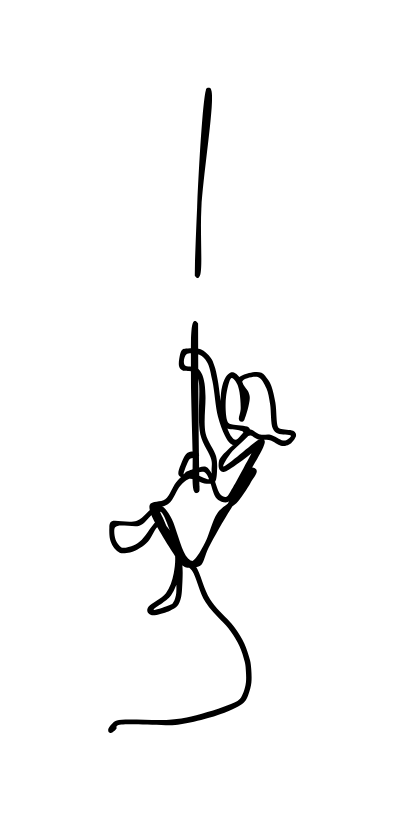
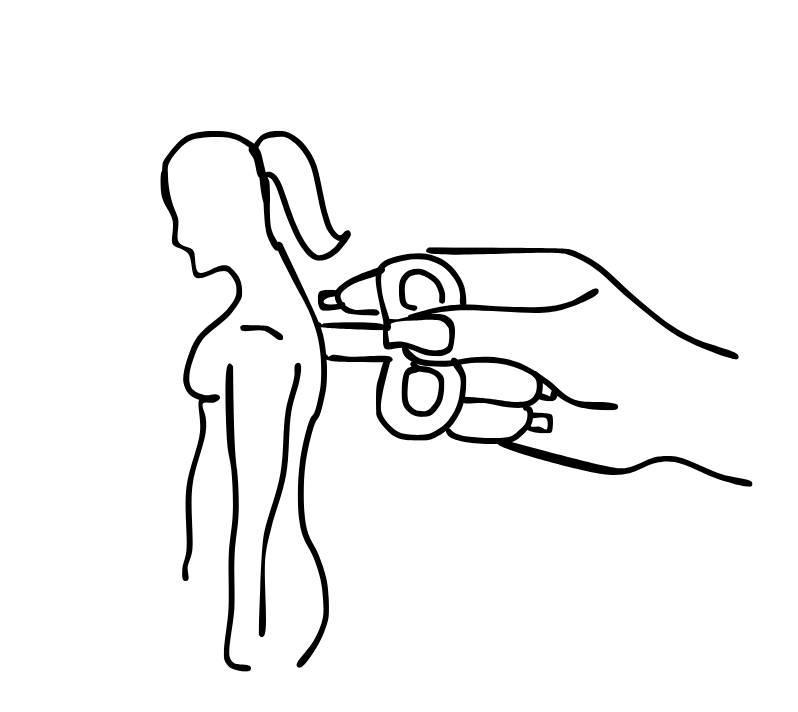
Separating from an enmeshed dynamic is a deeply complex and personal endeavor-and I’m not entirely sure I’ve fully “cut the cord” yet. I wonder if it’s even possible to completely sever such ties, or if it’s more about loosening the grip of that invisible string…
It was in the therapy room where I first spoke of the word ‘enmeshment’, and it was in the therapy space that I began to unravel, safely, years of pain with an adult who could hold space for my experiences. See, even though my parent had tried to listen to me, I rarely felt heard, seen, contained (Bion, 1962); my parent’s emotional needs always came first.
During my teens, when my parent would exhibit upset or leaned on me for comfort, I felt a burning rage, and then an emptyness. All the compassion and empathy I once had for them had been drained out of me. I was running on empty.
Throughout therapy I started to uncover the nuances of this dynamic and why I had grown to feel so cold and distant toward this parent, a complaint my parent would often make, expressing disappointment in my lack of warmth toward them.
I remember friends who would witness my relationship with my parent and tell me that I was being rude, or mean, or snappy- if only they could have understood why. And the why is because, well, I was angry. Angry at the years of emotional caretaking I had been subject to. Angry at the imbalance in our roles. Angry that I had no idea how to escape it, or what it even was- angry that they felt entitled to my support, isn’t that a parents job?
The process of separating began, quite literally, with physical distance. I spent much of my teenage years in boarding school, a space I remain deeply grateful for. It offered the structure, consistency, and calm that my home life lacked. After boarding school came university, and eventually, two years ago, I moved into my first apartment.
Creating physical distance from a parent with whom you’re too closely bonded can also in turn create psychological space. While enmeshment often feels like a string that cannot be severed, I began to feel a semblance of distance once I was no longer living with them, and better yet, could choose autonomously when I would see them. Finally having a space that was mine- I remember I cried for a week, filled with gratitude and relief that my home finally felt safe.
All of this is to say, physical distance from my parent, and the extensive work that took place in the therapeutic space were fundamental in helping me ‘cut the cord’.
Rage, Guilt, Repeat: Breaking the Cycle

There’s a common cycle my parent and I seem to enter, which I’ve coined ‘rage, guilt, and repeat’.
- An emotional outburst
- “I’m so sorry, I did this because… and you should forgive me because……”
- Another emotional outburst
This is a rather over-simplified example of the cycle, but I am trying to be mindful to not share too much of the intricacies our interpersonal dynamic.
But this is the gist: my parent emotionally explodes, feels an overwhelming sense of guilt, finds an explanation or justification for their behaviour, and then demands my forgiveness- and then repeat. They need me to accept them, comfort them, love them…gosh even writing this I feel a burning inside me. But see, this burning feeling? It’s useful, it’s a signal. The anger shows me where I need to protect myself, where something needs to change.
The most accessible way out of the cycle, for me, was to disengage, or well, to implement some boundaries...
Well, that’s the end of part 1.
In part 2, I’ll be sharing how I try to navigate this dynamic, how I learnt to set boundaries and more.
Parent, if you happen to have read this, I hope you understand, that I do understand you. I was forced to understand you as a child, but as an adult I have chosen to understand you. And with that understanding, I hold both hurt and hope.
Further Reading
Bowlby, J. (1969). Attachment. Hogarth Press.
Bion, W. R. (1962). Learning from experience. Tavistock Publications.
Gibson, L. C. (2015). Adult children of emotionally immature parents: How to heal from distant, self-involved, and unavailable parents. New Harbinger Publications.
Winnicott, D. W. (1986). The child in the family. In The child and the family (pp. 1-44). Tavistock Publications.
Winnicott, D. W. (1971). Playing and reality. Tavistock Publications
 My internal world
Leave a reply to Surviving an emotionally volatile parent (Part two) Boundaries, Contact or no contact, What now? – My internal world Cancel reply